- Joined
- Aug 14, 2025
- Messages
- 14,049
- Solutions
- 27
- Online time
- 1mo 25d
- Reputation
- 56,789
- Location
- Mothers basement
The pineal gland undoubtedly has an effect on one’s appearance and mental health but it’s also just a pretty interesting subject within itself. That something so tiny has been usedas a symbol throughout generations and is also the only unpaired organ in the brain
What is your pineal gland?
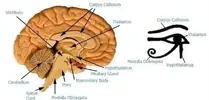
It is a pea sized, pinecone shaped, endocrine gland located in your epithalamus. In the center of the brain. This glands primary function is the secretion of melatonin/regulating your circadian rhythm.

When it’s light out, the light enters your eyes and signals the suprachiasmatic nucleus (also known as your biological clock), triggering the nucleus to inhibit the rest of the pathways. So it shuts down melatonin synthesis. However when it’s dark out, this pathway isn’t blocked and the signals travel through the PVN and goes down to the upper thoracic spinal cord, and reaches the cervical ganglion in your neck. Neurons in the ganglion will release norepinephrine to the pineal gland which causes melatonin production. The norepinephrine binds to the β-adrenergic receptors on the pinealocytes, triggers cAmp, which then turns on the AANAT enzyme (the enzyme that converts serotonin to N-acetylserotonin). Which is how the melatonin is produced.


As you age, your pineal gland calcifies. Melatonin levels decrease as you age due to the calcification of the gland, so melatonin secretion declines (aging is correlated with getting worse sleep). Little crystals of many different kinds of minerals (primarily hydroxyapatite, calcium and phosphate) accumulate around the gland.
There have been reported cases of infants with calcified pineal glands, so age isn’t proven to be the only factor of calcification. According to many spiritual beliefs, some people believe decalcifying it is the key to unlock divine insight, spiritual awakenings, perception beyond ordinary sight, and more.
However scientifically speaking, theres no actual “confirmed” method to genuinely decalcify the gland other than some intensive surgery.
Ancient Theology
The third eye is a symbol that has been used for centuries, embedded across China, india, and Southeast Asia. It’s mentioned in many spiritual and religious belief systems prevalent in Asia, like Buddhism, Hinduism, and Taoism. Representing inner wisdom, the subconscious/intuition. 16th century philosopher Rene Descartes referred to it as the “seat of the soul”. Popular theories also compare the third eye to the Egyptian “eye of Horus” since it looks like the map of the brain. Both concepts represent higher consciousness.

An interesting detail about the gland is that the crystals on it are magnetic. So in spiritual terms, people believe it can attract your desires.
Some ideologies believe the closer you are to the deity you worship, the more decalcified your gland is.
It is said in some religions, that the concept is evil/forboden (atleast this was how I heard about it). Some Christian’s view it as an enemy to the Holy Spirit, or that the desire to open your third eye is Satans temptation. A claim that really creeped me out personally is that it will allow you to see the supernatural, and evil things that you don’t normally see. Some even say it can cause psychosis if you don’t “ground yourself to the physical world” (root chakra). But anyways!
Misconceptions
1) Popularized by Dr. Rick Strassman, there is a hypothesis that the pineal gland produces DMT (a naturally occuring psychedelic that can give you out of body experiences), and that decalcifying it would improve this production. Unfortunately this guy wasn’t able to finish his experiments on this theory and was frustrated trying to fit his “spiritual questions into a biomedical research design.”https://psychiatryonline.org/doi/10...-hO70vRXgi92UOUnJOQ4y0N3DTwbpXl3mV.HmlkHH0I8#
It’s been confirmed that DMT is present in the brains of certain animals like rodents, but when it comes to the human pineal gland, there’s not much evidence on it. There are definitely trace amounts of it in the human brain, but not enough to actually produce any psychedelic experiences. The pineal gland itself would have to produce 25mg of DMT to cause one of these experiences, and it only produces about 0.1-0.9mg of melatonin every day.
2) A popular belief is that fluoride intake contributes to calcification, but there are very limited studies on this. Fluoride naturally builds up on its own since it’s attracted to calcium, so it doesn’t initiate calcium. Hence initiate calcification. However fluoride consumption isn’t really needed for human survival, so the act of avoiding it wouldn’t be an issue either way. https://www.nelsonavedental.com/sin...l gland calcify,in the pineal gland increases.
3) It is said by some that consuming calcium contributes to calcification of the gland, and while this may make sense to some, it’s false. Intake of calcium into the bloodstream is way different from the buildup of calcium in the pineal gland. Your body isn’t gonna throw excess calcium you consume into the third ventricle of the brain. That’s not how calcification works lmao
What is actually proven to help the pineal gland
Blue light glasses
Wearing glasses with blue light protection will shield you against artificial lighting which interferes with your circadian rhythm. The circadian rhythm is especially sensitive to blue light wavelengths 460–480nm (the average cellular device) because of the melanopsin in your eyes. (TURN OFF YOUR DAMN PHONE AN HOUR BEFORE BED )
)
Sunlight
This will boost your general mood and help your circadian rhythm too. Studies have shown that it helps your brain produce more melatonin at night.
Antioxidants
Foods that reduce oxidative stress are helpful, since reactive oxygen species are harmful on the gland. Vitamin c rich fruits like citruses, strawberries, tart cherries help. Along with peppers, broccoli, and leafy greens. Turmeric is also a powerful plant rich in antioxidants.
Stress management
High cortisol interferes with the function of the pineal gland. Cortisol also interferes with the production of other hormones, like testosterone. So managing your stress is very important, and it will make you feel and look much better.
Now reducing cortisol obviously won’t “increase” your natural test levels, but many peoples levels aren’t where they can be due to cortisol. Cortisol suppresses testosterone production because both are created from cholesterol. So if there is more cortisol being produced, less testosterone will be produced. This fact is WATER
So what is one powerful thing that is PROVEN to help with your cortisol?
This brings us to the fun part…
Meditation
This is a high T hobby that is proven to reduce cortisol levels, and help you regulate your emotions.
And it’s an esoteric practice that is used throughout different spiritual ideologies that is said to be able to decalcify the pineal gland. There’s no scientific proof that it does, but I will say doing third eye meditation can trip someone out. Lots of people who do it can feel a tingling sensation on their third eye during the process.
There are some studies showing people who meditate produce greater levels of melatonin.
https://pubmed.ncbi.nlm.nih.gov/10876066/
Key aspects of meditating:
Find a comfortable spot to sit, anywhere but your bed
Close your eyes duh
You can listen to calming music/frequencies (optional) different frequencies often have specific meanings/are meant to evoke certain feelings
Transcendial mediation
This form of meditation is very simple and well known. It’s when you meditate using a mantra. A word/affirmation (like “om” for example) that you keep repeating over and over again until it slowly fades into the background. This word is to help anchor you and help your thoughts slowly dissipate away. Some people have been able to combine this form of meditation with third eye meditation: while you repeat your mantra over and over again you slowly look up and focus on the space between your eyebrows.
The routine: sit comfortably for a few minutes, eyes closed. Introduce a mantra. While you feel your mind get distracted by thoughts (this will inevitably happen), you need to slowly steer yourself back to the mantra and let it ground you, slowly feel your thoughts eventually drift away. Many people practice this for 15-20 minutes every day.
Trataka candle
This one I feel is more powerful and I really wanna try it at some point. Trataka/candle meditation/candle gazing is when you light a candle about an arms length away from you, and it should be at eye level. From here, you want to close your eyes for a bit and then open them and stare into the tip of the flame. Concentrating on the flame is what grounds you to be present in the moment, away from wandering thoughts. This is practiced best in a dark room because that way you’ll only be able to concentrate on the candle.
Routine: Light the candle. Close your eyes for a bit, open them and stare into the flame until your eyes can’t handle it. Once you must blink, close your eyes and visualize that flame in your mind and pretend as though that imagine is being projected between your eyebrows (on your third eye). After it fades, that means you’ve completed one round.
Visualization
This is more of a simple way to go about it. Visualization meditation is meditating, but adding in a component of visualization to it. Once you reach a calm, anchored state, you can start to try and visualize imagery. Some people visualize ripping open a third eye open between their brows, or a beam of light shining from their third eye. I myself have tried this and it can give you such a strange tingling sensation, or even feelings of shock.
Routine: close your eyes for a moment, meditate with a chakra, counting your breathing, or anything to help anchor yourself, once you reach a flow state start to implement visualizations
Mudras
These are sacred hand signals some people do during meditation, often representing different things. Sometimes called “hand yoga”, they help enhancing concentration. There’s one called the Hakini mudra that’s primarily used for “activating” the third eye.

Are there any other ways u guys meditate? @ecoli @foidslayer @Fidelis @Glamour @TonyDr @LaWi

What is your pineal gland?
It is a pea sized, pinecone shaped, endocrine gland located in your epithalamus. In the center of the brain. This glands primary function is the secretion of melatonin/regulating your circadian rhythm.
When it’s light out, the light enters your eyes and signals the suprachiasmatic nucleus (also known as your biological clock), triggering the nucleus to inhibit the rest of the pathways. So it shuts down melatonin synthesis. However when it’s dark out, this pathway isn’t blocked and the signals travel through the PVN and goes down to the upper thoracic spinal cord, and reaches the cervical ganglion in your neck. Neurons in the ganglion will release norepinephrine to the pineal gland which causes melatonin production. The norepinephrine binds to the β-adrenergic receptors on the pinealocytes, triggers cAmp, which then turns on the AANAT enzyme (the enzyme that converts serotonin to N-acetylserotonin). Which is how the melatonin is produced.
As you age, your pineal gland calcifies. Melatonin levels decrease as you age due to the calcification of the gland, so melatonin secretion declines (aging is correlated with getting worse sleep). Little crystals of many different kinds of minerals (primarily hydroxyapatite, calcium and phosphate) accumulate around the gland.
There have been reported cases of infants with calcified pineal glands, so age isn’t proven to be the only factor of calcification. According to many spiritual beliefs, some people believe decalcifying it is the key to unlock divine insight, spiritual awakenings, perception beyond ordinary sight, and more.
However scientifically speaking, theres no actual “confirmed” method to genuinely decalcify the gland other than some intensive surgery.
Ancient Theology
The third eye is a symbol that has been used for centuries, embedded across China, india, and Southeast Asia. It’s mentioned in many spiritual and religious belief systems prevalent in Asia, like Buddhism, Hinduism, and Taoism. Representing inner wisdom, the subconscious/intuition. 16th century philosopher Rene Descartes referred to it as the “seat of the soul”. Popular theories also compare the third eye to the Egyptian “eye of Horus” since it looks like the map of the brain. Both concepts represent higher consciousness.
An interesting detail about the gland is that the crystals on it are magnetic. So in spiritual terms, people believe it can attract your desires.
Some ideologies believe the closer you are to the deity you worship, the more decalcified your gland is.
It is said in some religions, that the concept is evil/forboden (atleast this was how I heard about it). Some Christian’s view it as an enemy to the Holy Spirit, or that the desire to open your third eye is Satans temptation. A claim that really creeped me out personally is that it will allow you to see the supernatural, and evil things that you don’t normally see. Some even say it can cause psychosis if you don’t “ground yourself to the physical world” (root chakra). But anyways!
Misconceptions
1) Popularized by Dr. Rick Strassman, there is a hypothesis that the pineal gland produces DMT (a naturally occuring psychedelic that can give you out of body experiences), and that decalcifying it would improve this production. Unfortunately this guy wasn’t able to finish his experiments on this theory and was frustrated trying to fit his “spiritual questions into a biomedical research design.”https://psychiatryonline.org/doi/10...-hO70vRXgi92UOUnJOQ4y0N3DTwbpXl3mV.HmlkHH0I8#
It’s been confirmed that DMT is present in the brains of certain animals like rodents, but when it comes to the human pineal gland, there’s not much evidence on it. There are definitely trace amounts of it in the human brain, but not enough to actually produce any psychedelic experiences. The pineal gland itself would have to produce 25mg of DMT to cause one of these experiences, and it only produces about 0.1-0.9mg of melatonin every day.
2) A popular belief is that fluoride intake contributes to calcification, but there are very limited studies on this. Fluoride naturally builds up on its own since it’s attracted to calcium, so it doesn’t initiate calcium. Hence initiate calcification. However fluoride consumption isn’t really needed for human survival, so the act of avoiding it wouldn’t be an issue either way. https://www.nelsonavedental.com/sin...l gland calcify,in the pineal gland increases.
3) It is said by some that consuming calcium contributes to calcification of the gland, and while this may make sense to some, it’s false. Intake of calcium into the bloodstream is way different from the buildup of calcium in the pineal gland. Your body isn’t gonna throw excess calcium you consume into the third ventricle of the brain. That’s not how calcification works lmao
What is actually proven to help the pineal gland
Blue light glasses
Wearing glasses with blue light protection will shield you against artificial lighting which interferes with your circadian rhythm. The circadian rhythm is especially sensitive to blue light wavelengths 460–480nm (the average cellular device) because of the melanopsin in your eyes. (TURN OFF YOUR DAMN PHONE AN HOUR BEFORE BED
)Sunlight
This will boost your general mood and help your circadian rhythm too. Studies have shown that it helps your brain produce more melatonin at night.
Antioxidants
Foods that reduce oxidative stress are helpful, since reactive oxygen species are harmful on the gland. Vitamin c rich fruits like citruses, strawberries, tart cherries help. Along with peppers, broccoli, and leafy greens. Turmeric is also a powerful plant rich in antioxidants.
Stress management
High cortisol interferes with the function of the pineal gland. Cortisol also interferes with the production of other hormones, like testosterone. So managing your stress is very important, and it will make you feel and look much better.
Now reducing cortisol obviously won’t “increase” your natural test levels, but many peoples levels aren’t where they can be due to cortisol. Cortisol suppresses testosterone production because both are created from cholesterol. So if there is more cortisol being produced, less testosterone will be produced. This fact is WATER
So what is one powerful thing that is PROVEN to help with your cortisol?
This brings us to the fun part…
Meditation
This is a high T hobby that is proven to reduce cortisol levels, and help you regulate your emotions.
And it’s an esoteric practice that is used throughout different spiritual ideologies that is said to be able to decalcify the pineal gland. There’s no scientific proof that it does, but I will say doing third eye meditation can trip someone out. Lots of people who do it can feel a tingling sensation on their third eye during the process.
There are some studies showing people who meditate produce greater levels of melatonin.
https://pubmed.ncbi.nlm.nih.gov/10876066/
https://pmc.ncbi.nlm.nih.gov/articles/PMC11822093/Either way, facilitation of higher physiological melatonin levels at appropriate times of day might be one avenue through which the claimed health promoting effects of meditation occur.
Increased melatonin levels, as well as increased fMRI BOLD signal in the pineal gland, have been observed in meditators versus controls.
Key aspects of meditating:
Find a comfortable spot to sit, anywhere but your bed
Close your eyes duh
You can listen to calming music/frequencies (optional) different frequencies often have specific meanings/are meant to evoke certain feelings
Transcendial mediation
This form of meditation is very simple and well known. It’s when you meditate using a mantra. A word/affirmation (like “om” for example) that you keep repeating over and over again until it slowly fades into the background. This word is to help anchor you and help your thoughts slowly dissipate away. Some people have been able to combine this form of meditation with third eye meditation: while you repeat your mantra over and over again you slowly look up and focus on the space between your eyebrows.
The routine: sit comfortably for a few minutes, eyes closed. Introduce a mantra. While you feel your mind get distracted by thoughts (this will inevitably happen), you need to slowly steer yourself back to the mantra and let it ground you, slowly feel your thoughts eventually drift away. Many people practice this for 15-20 minutes every day.
Trataka candle
This one I feel is more powerful and I really wanna try it at some point. Trataka/candle meditation/candle gazing is when you light a candle about an arms length away from you, and it should be at eye level. From here, you want to close your eyes for a bit and then open them and stare into the tip of the flame. Concentrating on the flame is what grounds you to be present in the moment, away from wandering thoughts. This is practiced best in a dark room because that way you’ll only be able to concentrate on the candle.
Routine: Light the candle. Close your eyes for a bit, open them and stare into the flame until your eyes can’t handle it. Once you must blink, close your eyes and visualize that flame in your mind and pretend as though that imagine is being projected between your eyebrows (on your third eye). After it fades, that means you’ve completed one round.
Visualization
This is more of a simple way to go about it. Visualization meditation is meditating, but adding in a component of visualization to it. Once you reach a calm, anchored state, you can start to try and visualize imagery. Some people visualize ripping open a third eye open between their brows, or a beam of light shining from their third eye. I myself have tried this and it can give you such a strange tingling sensation, or even feelings of shock.
Routine: close your eyes for a moment, meditate with a chakra, counting your breathing, or anything to help anchor yourself, once you reach a flow state start to implement visualizations
Mudras
These are sacred hand signals some people do during meditation, often representing different things. Sometimes called “hand yoga”, they help enhancing concentration. There’s one called the Hakini mudra that’s primarily used for “activating” the third eye.
Are there any other ways u guys meditate?
@ecoli @foidslayer @Fidelis @Glamour @TonyDr @LaWi