
- Joined
- Nov 5, 2024
- Messages
- 12,246
- Solutions
- 2
- Online time
- 22d 22h
- Reputation
- 46,378
Link the study, I wanna know if this is legit or not
I couldn't find a study.

Follow along with the video below to see how to install our site as a web app on your home screen.
Note: This feature may not be available in some browsers.
Link the study, I wanna know if this is legit or not

Link the study, I wanna know if this is legit or not
I couldn't find a study.
actually physical reaction + cognitive speed is a small subsection of the test, specifically block design, symbol search, and codingAlso the stereotypical nerd with high IQ but absolutely horrible at anything physical

Doesn't use a standardized test like we do todayWhat is the average IQ of Nobel Laureates?
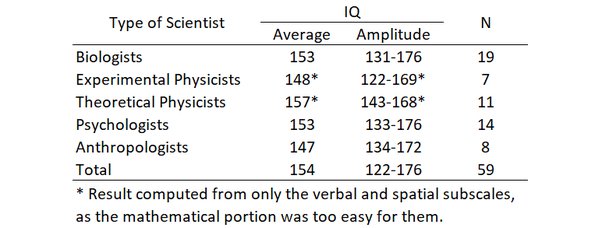
Anne Roe studied 64 of the best scientists in the US in 1952 (20 biologists, 22 physicists and 22 social scientists), including Nobel Prize winners. Her findings regarding global IQ can be summarized as shown in the table below.
The results according to the verbal, spatial and mathematical subscales are:
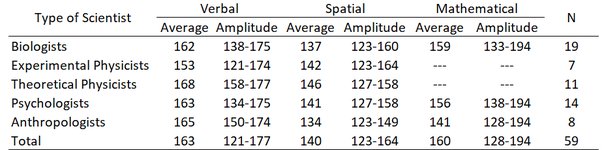
As one can see, the overall results were very high, in the top 0.015%, but the results varied substantially according to field and subtest.
Biologists and psychologists performed better in verbal and mathematical tests, obtaining relatively lower scores in the spatial test. Anthropologists performed better on the verbal test, obtaining lower results in the mathematical test and lower still in the spatial test. Although most physicists did not undergo the mathematical test, one can reasonably assume that, perhaps because of specific training in this type of thinking during their education, they would achieve their best performance in such a test, being their second best performance in the verbal test and the spatial test the worst.Among biologists, geneticists and biochemists performed relatively better on the nonverbal test while the other biologists obtained relatively better results on the verbal test. Theoretical physicists showed some tendency to perform relatively better in the verbal test while the experimental ones stood out more in the space test. Among social scientists, experimental psychologists are relatively better off in spatial or mathematical tests than anthropologists.
It is interesting to note that the mean of 154 observed for the total sample is very close to the ratio of 1 for every 4000 (equivalent to an IQ of 156) found by Galton (1869) and to the mean IQ of 155 obtained by Cox (1926) in their studies of geniuses. This suggests a relative stability for the mean level of intelligence for the extremely successful thinkers across domains, countries and time.
References
- Cox, C. M. (1926). The Early Mental Traits of Three Hundred Geniuses. Volume II. Genetic Studies of Genius. Stanford, California: Stanford University Press (Reprinted in 1959).
- Galton, F. (1869). Hereditary Genius: An Inquiry into Its Laws and Consequences. London: Macmillan, p. 1 (Reprinted, Bristol: Thoemmes Press, 1999).
- Roe, A. (1953). ''The making of a scientist.'' New York, NY: Dodd, Mead.
This actually makes more sensei will say i was somewhat mistaken, looks like some studies showed an avg of nobel prize winners in chemistry had an avg of 136 and another study quoted something like 145 as the avg, with 147 in physics
true idk what they used tbh !Doesn't use a standardized test like we do today
yeah i agree but i will say that my hunch is that most have a very high spike in their profile, higher than the test could score forThis actually makes more sense
I Would love to see a modern study done with the scientists today with a highly regarded test like the WAIS 4
iq tests are renormed every 10~ years or so to account for the 3~ pt increase in average population IQ so he would have scored lower than you on the test that you took jflI also have the 2nd highest iq in my family my dad just always reminds me his is 134