Deleted Member 107512
Active member
- Joined
- Feb 7, 2026
- Messages
- 189
- Online time
- 1d 8h
- Reputation
- 186
>chatgpt race denialism kinda shitad-hominem isn't a logical fallacy, idk why do you brought this shit up.
race wasn't debunked in the 20th century, and to prove existence of race you can just look at what subhumans from africa/middle east/asia etc look like and compare them to people from europe. This is a great empirical proof.
I didn't use ChatGPT, but even I did, that wouldn't render any of my statements invalid; the strength or weakness of my arguments may ir may not do that.
By definition, a logical fallacy is faulty reasoning even if there is truth to that fallacy. Even IF I used ChatGPT (which is incorrect but even if), that does NOT harm my argument.
Now, as for the concept of "race" being debunked back in the 20th century. I'll even quote the most relevant parts when and where necessary:
"The subspecies concept and its taxonomic application. The subspecies concept" by E. O. Wilson 1953.
"On the Non-Existence of Human Races" by Frank Livingstone 1962
"There are no races, only clines."
"The History and Geography of Human Genes" by Luigi Luca Cavalli-Sforza 1994:
"From a scientific point of view, the concept of race has failed to obtain any consensus; none is likely, given the gradual variation in existence. It may be objected that the racial stereotypes have a consistency that allows even the layman to classify individuals. However, the major stereotypes, all based on skin color, hair color and form, and facial traits, reflect superficial differences that are not confirmed by deeper analysis with more reliable genetic traits and whose origin dates from recent evolution mostly under the effect of climate and perhaps sexual selection".
"Statement on 'Race'" by the American Anthropological Association 1998
"In the United States both scholars and the general public have been conditioned to viewing human races as natural and separate divisions within the human species based on visible physical differences. With the vast expansion of scientific knowledge in this century, however, it has become clear that human populations are not unambiguous, clearly demarcated, biologically distinct groups. Evidence from the analysis of genetics (e.g., DNA) indicates that most physical variation, about 94%, lies within so-called racial groups. Conventional geographic "racial" groupings differ from one another only in about 6% of their genes. This means that there is greater variation within "racial" groups than between them. In neighboring populations there is much overlapping of genes and their phenotypic (physical) expressions. Throughout history whenever different groups have come into contact, they have interbred. The continued sharing of genetic materials has maintained all of humankind as a single species. ... With the vast expansion of scientific knowledge in this century, ... it has become clear that human populations are not unambiguous, clearly demarcated, biologically distinct groups. ... Given what we know about the capacity of normal humans to achieve and function within any culture, we conclude that present-day inequalities between so-called "racial" groups are not consequences of their biological inheritance but products of historical and contemporary social, economic, educational, and political circumstances."
"Human Races: A genetic and evolutionary perspective" by Alan R Templeton 1998:
"Genetic surveys and the analyses of DNA haplotype trees show that human 'races' are not distinct lineages, and that this is not due to recent admixture; human 'races' are not and never were 'pure'."
Now this is from 2008, but the author (Jonathan Marks) notes:
By the 1970s, it had become clear that (1) most human differences were cultural; (2) what was not cultural was principally polymorphic – that is to say, found in diverse groups of people at different frequencies; (3) what was not cultural or polymorphic was principally clinal – that is to say, gradually variable over geography; and (4) what was left – the component of human diversity that was not cultural, polymorphic, or clinal – was very small.
A consensus consequently developed among anthropologists and geneticists that race as the previous generation had known it – as largely discrete, geographically distinct, gene pools – did not exist."
>and to prove existence of race you can just look at what subhumans from africa/middle east/asia etc look like and compare them to people from europe. This is a great empirical proof.
The "Middle East" and "Europe" are meaningless terms and boundaries between them are vague. Is Turkey "European", "Middle Eastern", "both" or "none"? Some organisations list Turkey, Armenia, Azerbaijan, Cyprus, Georgia as "completely European" or "completely West Asian". Do we take the UK approach and consider all of Turkey (including the parts bordering Iraq and Iran) "Europe" or the Netherlands approach where none of it is in "Europe" or do we mix or match or reject both approaches?
Do people from Malaga constitute a "different race" from people from the Basque region? If not, why not? They're differentiated to a degree genetically. Are people from Malaga closer to Syrians than they are to Finns? (Yes, but it's NOT due to skin colour overlap)
Actually, let's talk about genetic distance!
"Human races are not like dog breeds: refuting a racist analogy" by Norton et al 2019:
:In 2004, Parker and colleagues analyzed data from single nucleotide polymorphisms (SNPs) for 120 dogs representing 60 breeds as well as 96 microsatellite loci genotyped in 414 dogs representing 85 breeds. Both STR and SNP data demonstrated low levels of within-breed heterozygosity, indicating that within breed genetic variation was low (H = 0.313–0.610), while FST estimates also indicated high levels of differentiation among breeds (FST = 0.33)."
"Parker et al.’s analysis of dog population structure can be compared to an earlier study of human population structure using similar methods (Rosenberg et al. 2002). In this paper, Rosenberg and colleagues utilized allele frequency data from 377 microsatellites genotyped in the 52 populations of the HGDP-CEPH Human Genome Diversity Panel. Rosenberg et al. conducted AMOVA that examined genetic variance components within and among the individual populations of the HGDP-CEPH as well as within and among five and seven broad geographical groupings of these populations. These regional groups can be viewed as generally analogous to continental regions and U.S. census groupings (the seven-region scheme divides Europe/Middle East/Central Asia into three separate categories). The authors observed that genetic differences among regions accounted for only 3.3–4.7% of global human genetic variation (much smaller than the 27% of genetic differences among dog breeds reported by Parker et al. 2004), and that variation within populations accounts for ~ 92.9–94.3%. Differences among populations within regions accounted for 2.4–2.6% of the remaining genetic variation. In addition, within-region levels of heterozygosity (0.664–0.792; Rosenberg et al. 2002) were notably higher than those observed for dog breeds (0.313–0.610; Parker et al. 2004). This reflects the much greater total genetic variation within human groups compared to dog breeds. These results are comparable to those from other human datasets/populations, including HGDP-CEPH multilocus SNP data (Li et al. 2008). Furthermore, data from The 1000 Genomes Project demonstrates that FST values between continental groups are far lower (0.052–0.083) than FST values for dog breeds (The 1000 Genomes Project Consortium 2015). In sum, these data suggest that a greater degree of global genetic variation in humans can be attributable to variation within local populations, rather than between regional (racial) groups, and that substantial heterogeneity can be found within these groups. This stands in marked contrast to the lower levels of heterozygosity observed within dog breeds and the large amount of genetic variation that can be explained by breed differences."
Because I know some people like to compare humans to dogs. We're awfully homogenous as a species; human populations aren't akin to breeds let alone subspecies.
Now let's zoom on on the 0.052–0.083 FST figure. An intermediate value is ~0.068. So let's compare the most "divergent Middle Eastern populations" to the most "divergent European populations" using FST values from this study:
Genome-wide analysis of Corsican population reveals a close affinity with Northern and Central Italy - PMC
Despite being the fourth largest island in the Mediterranean basin, the genetic variation of Corsica has not been explored as exhaustively as Sardinia, which is situated only 11 km South. However, it is likely that the populations of the two islands ...
 pmc.ncbi.nlm.nih.gov
"Genome-wide analysis of Corsican population reveals a close affinity with Northern and Central Italy" by Tamm et al 2019:
Yemenese-Latvian: 0.031
So the most divergent Western Eurasian pairing is LESS than HALF as distant as the continental average, 10x smaller than the differences between dog breeds and yet you're telling me that Latvians and Yemenis constitute "different races"?
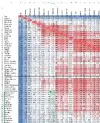
I also took it upon myself to find various distances between various so-called Europeans and so-called Middle Easterners.
(I marked the value between Yemenis and Latvians with a dot. I also did a value between France/Germany with Turks and Southern Caucasus populations and without Turks incase you wish to cope with Turks)
In any event, Western Eurasian variance is limited. There is no meaningful "European" vs "Middle Eastern" genetic zone; as various "Middle Easterners" are more distant to "fellow Middle Easterners" than they are to "Europeans" and vice versa.
If you believe an artificial boundary made by the British means anything, it says more about you than it does me.
Attachments
-
 Screenshot_20260208_090048_WPS Office.webp253.8 KB · Views: 9
 -
 Screenshot_20260208_090216_WPS Office.webp412 KB · Views: 11
 -
 Screenshot_20260208_090439_WPS Office.webp201.4 KB · Views: 7
 -
 Screenshot_20260208_090609_WPS Office.webp344.6 KB · Views: 8
 -
 Screenshot_20260208_090750_WPS Office.webp274.8 KB · Views: 9
 -
 Screenshot_20260208_091122_WPS Office.webp283.5 KB · Views: 8
 -
 Screenshot_20260208_091526_WPS Office.webp145.3 KB · Views: 10
 -
 Screenshot_20260208_091649_WPS Office.webp101.3 KB · Views: 9
 -
 Screenshot_20260208_091914_WPS Office.webp98.9 KB · Views: 9
 -
 Screenshot_20260208_091955_WPS Office.webp155.8 KB · Views: 7
 -
 Screenshot_20260208_092834_WPS Office.webp552.4 KB · Views: 9
Last edited:
