
Altava
Well-known member
- Joined
- Jun 10, 2026
- Messages
- 231
- Solutions
- 1
- Online time
- 1d 9h
- Reputation
- 433
before vs after
Laser eye colour change is safer than people think, being the safest procedure with the most aesthetically pleasant results compared to implants and tattooing your iris but could still be dangerous especially when aiming to avoid repigmentation while the safer version of it could cause your eye to somewhat repigment although a complete return to its original colour is rare. This is not a promotion or condemnation of it but a weigh in on the pros and cons 
Laser treatment to lighten your eyes is much safer than implants that are highly dangerous and look unnatural and cheap, in contrast the laser procedure gives you a more natural and authentic look since all it does is destroy pigment which is why your eye is brown to begin with. However people have sometimes exaggerated how safe it is because of the difference between it and the other treatments, claiming that the worst complication if the treatment is administered correctly is having to take some medicine for a while due to inflammation and similar minor things. Some others on the opposing side have been exaggerating how dangerous it is, putting it in the same basket as keratopigmentation (iris tattooing) or iris implants. Taking advantage of the fact that some of these treatments are assisted with laser (while not being pure laser depigmentation procedures). Either way the documented complications are MUCH fewer but it could partially be due to how new this treatment is. I just felt like it never hurts to be aware of everything surrounding this very appealing procedure.
Stats :
25% Short-Term Complication Rate: In the largest prospective study to date evaluating 1,176 eyes undergoing pure laser iris depigmentation, 25% of patients developed transient iritis (inflammation of the iris). While these cases resolved with topical anti-inflammatory drops, it represents a standard post-operative complication.
source: https://pmc.ncbi.nlm.nih.gov/articles/PMC12271006/
0% Reported Severe Glaucoma Cases (Manufacturer Data): In smaller, early-phase international trials conducted by proprietary developers (such as Strōma Medical), 0% of the initial 64 trial patients experienced increased intraocular pressure (IOP) or pigmentary glaucoma. However, the sample sizes remain too small to establish definitive universal safety margins.
source : https://link.springer.com/article/10.1007/s40123-025-01177-0
25% Short-Term Complication Rate: In the largest prospective study to date evaluating 1,176 eyes undergoing pure laser iris depigmentation, 25% of patients developed transient iritis (inflammation of the iris). While these cases resolved with topical anti-inflammatory drops, it represents a standard post-operative complication.
source: https://pmc.ncbi.nlm.nih.gov/articles/PMC12271006/
0% Reported Severe Glaucoma Cases (Manufacturer Data): In smaller, early-phase international trials conducted by proprietary developers (such as Strōma Medical), 0% of the initial 64 trial patients experienced increased intraocular pressure (IOP) or pigmentary glaucoma. However, the sample sizes remain too small to establish definitive universal safety margins.
source : https://link.springer.com/article/10.1007/s40123-025-01177-0
The American Academy of Ophthalmology (AAO) strongly warn against it due to a lack of independent, long-term scientific data, this is understandable due to how new this treatment is. It could be safer or more dangerous than it currently looks so I wanted to review what data is currently available on this.
While these statistics makes it look very safe, that impression is still heavily disputed by ophthalmologists as they express severe caution regarding how these statistics are packaged by private commercial clinics.
The "Sink Clogging" Risk : Pure laser depigmentation uses a low-energy laser to blast away the superficial melanin on your iris. Mainstream eye surgeons warn that this free-floating debris can clog the trabecular meshwork (the eye's natural drainage system), acting like a stopped-up sink.
Severe Outlier Risks: Isolated peer-reviewed case studies have documented permanent, severe outcomes including iatrogenic pigmentary glaucoma, chronic photophobia (extreme light sensitivity), and stromal atrophy.
The "ghost patient" effect :
Because these procedures are not FDA-approved, the vast majority of them take place in private cash-only clinics in countries like Panama, France, Italy, or Turkey.
No Central Registry : If a patient gets laser depigmentation abroad, flies home to Canada or the US, and develops high eye pressure three years later, they go to their local hometown optometrist.
Data Isolation: That local doctor treats the glaucoma but rarely publishes a formal medical paper about it.
Therefore, the complication is completely missed by the international data pools, making the procedure look much safer on paper than it is in reality.
While these statistics makes it look very safe, that impression is still heavily disputed by ophthalmologists as they express severe caution regarding how these statistics are packaged by private commercial clinics.
The "Sink Clogging" Risk : Pure laser depigmentation uses a low-energy laser to blast away the superficial melanin on your iris. Mainstream eye surgeons warn that this free-floating debris can clog the trabecular meshwork (the eye's natural drainage system), acting like a stopped-up sink.
Severe Outlier Risks: Isolated peer-reviewed case studies have documented permanent, severe outcomes including iatrogenic pigmentary glaucoma, chronic photophobia (extreme light sensitivity), and stromal atrophy.
The "ghost patient" effect :
Because these procedures are not FDA-approved, the vast majority of them take place in private cash-only clinics in countries like Panama, France, Italy, or Turkey.
No Central Registry : If a patient gets laser depigmentation abroad, flies home to Canada or the US, and develops high eye pressure three years later, they go to their local hometown optometrist.
Data Isolation: That local doctor treats the glaucoma but rarely publishes a formal medical paper about it.
Therefore, the complication is completely missed by the international data pools, making the procedure look much safer on paper than it is in reality.
The following show documented cases that could potentially occur as complications.
1 - The first case report outlines two devastating, concurrent complications in a patient who underwent laser eye color change:

image explanation :
''Slit-lamp photography of the right (1a) and left (1b) eye showing pigment deposits on the endothelium and the anterior lens capsule, with formation of posterior synechiae. The iris stroma is thinned out and pale in color, with dilated and fixed pupils. Transillumination defects shown in the right (1c) and left (1d) eyes. Color fundus photographs show intraretinal hemorrhages in the posterior pole of the right eye (1e) and the periphery of the left eye (1f). (For interpretation of the references to color in this figure legend, the reader is referred to the Web version of this article.)''
https://pmc.ncbi.nlm.nih.gov/articles/PMC10522941/
Severe Iatrogenic Pigmentary Glaucoma: The sheer volume of loose iris pigment completely choked the eye's drainage system. This triggered severe, nerve-crushing intraocular pressure spikes.
Paracentral Acute Middle Maculopathy (PAMM): This was a newly documented complication of the procedure. The intense energy from the laser caused a lack of blood flow (ischemia) to the middle layers of the retina. This leads to permanent blind spots right in the center of the patient's field of vision.
image explanation :
''Slit-lamp photography of the right (1a) and left (1b) eye showing pigment deposits on the endothelium and the anterior lens capsule, with formation of posterior synechiae. The iris stroma is thinned out and pale in color, with dilated and fixed pupils. Transillumination defects shown in the right (1c) and left (1d) eyes. Color fundus photographs show intraretinal hemorrhages in the posterior pole of the right eye (1e) and the periphery of the left eye (1f). (For interpretation of the references to color in this figure legend, the reader is referred to the Web version of this article.)''
https://pmc.ncbi.nlm.nih.gov/articles/PMC10522941/
Severe Iatrogenic Pigmentary Glaucoma: The sheer volume of loose iris pigment completely choked the eye's drainage system. This triggered severe, nerve-crushing intraocular pressure spikes.
Paracentral Acute Middle Maculopathy (PAMM): This was a newly documented complication of the procedure. The intense energy from the laser caused a lack of blood flow (ischemia) to the middle layers of the retina. This leads to permanent blind spots right in the center of the patient's field of vision.
2- Corneal Decompensation and Endothelial Burnout :
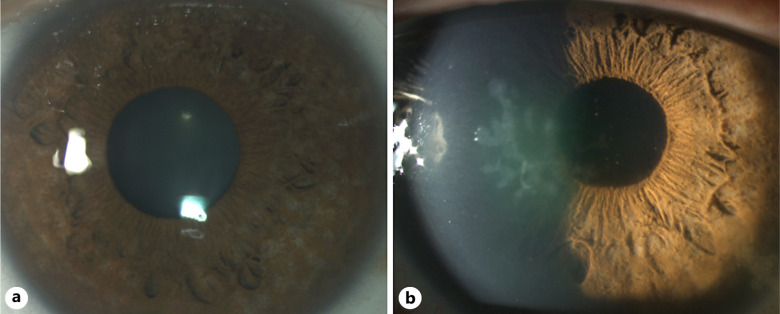
image explanation :
''Iris depigmentation herpes simplex keratitis after LID. a Slit-lamp image showing patchy hypopigmentation of the iris with multiple round laser-induced depigmented areas. b Dendritic epithelial lesion in the right cornea consistent with herpes simplex keratitis.''
https://pmc.ncbi.nlm.nih.gov/articles/PMC13075871/
The Damage: Studies show the acoustic shockwaves from cosmetic lasers inadvertently destroy the corneal endothelium. This is a delicate, single layer of non-regenerating cells behind the clear window of your eye.
The Consequence: Without these cells to pump out excess fluid, the cornea develops chronic swelling (corneal edema), turns permanently milky-white and cloudy, and requires a full corneal transplant to restore basic sight.
image explanation :
''Iris depigmentation herpes simplex keratitis after LID. a Slit-lamp image showing patchy hypopigmentation of the iris with multiple round laser-induced depigmented areas. b Dendritic epithelial lesion in the right cornea consistent with herpes simplex keratitis.''
https://pmc.ncbi.nlm.nih.gov/articles/PMC13075871/
The Damage: Studies show the acoustic shockwaves from cosmetic lasers inadvertently destroy the corneal endothelium. This is a delicate, single layer of non-regenerating cells behind the clear window of your eye.
The Consequence: Without these cells to pump out excess fluid, the cornea develops chronic swelling (corneal edema), turns permanently milky-white and cloudy, and requires a full corneal transplant to restore basic sight.
3 - Chronic Uveitic Glaucoma :
https://keratopigmentation-paris.co...keratopigmentation-wich-best-surgery-article/
The Damage: Firing a laser into the iris causes the eye to mount a massive, continuous immune response.
The Consequence: Clinical reports show this leads to chronic uveitis (severe internal eye inflammation). The constant presence of inflammatory proteins causes the iris to scar and stick to the lens (synechiae), permanently trapping fluid and necessitating emergency glaucoma filtration surgery.
https://keratopigmentation-paris.co...keratopigmentation-wich-best-surgery-article/
The Damage: Firing a laser into the iris causes the eye to mount a massive, continuous immune response.
The Consequence: Clinical reports show this leads to chronic uveitis (severe internal eye inflammation). The constant presence of inflammatory proteins causes the iris to scar and stick to the lens (synechiae), permanently trapping fluid and necessitating emergency glaucoma filtration surgery.
4 - Photophobia and Iris Sphincter Paralysis :
https://www.ncbi.nlm.nih.gov/books/NBK532248/
The Damage: The laser heat can accidentally scar the iris sphincter muscle, which controls pupil dilation and constriction.
The Consequence: The pupil becomes permanently dilated or warped. This triggers extreme, painful, and permanent photophobia (light sensitivity) because the eye can no longer narrow itself to block out harsh sunlight or glare.
https://www.ncbi.nlm.nih.gov/books/NBK532248/
The Damage: The laser heat can accidentally scar the iris sphincter muscle, which controls pupil dilation and constriction.
The Consequence: The pupil becomes permanently dilated or warped. This triggers extreme, painful, and permanent photophobia (light sensitivity) because the eye can no longer narrow itself to block out harsh sunlight or glare.
5 - Patchy Dyspigmentation and Aesthetic Failure :
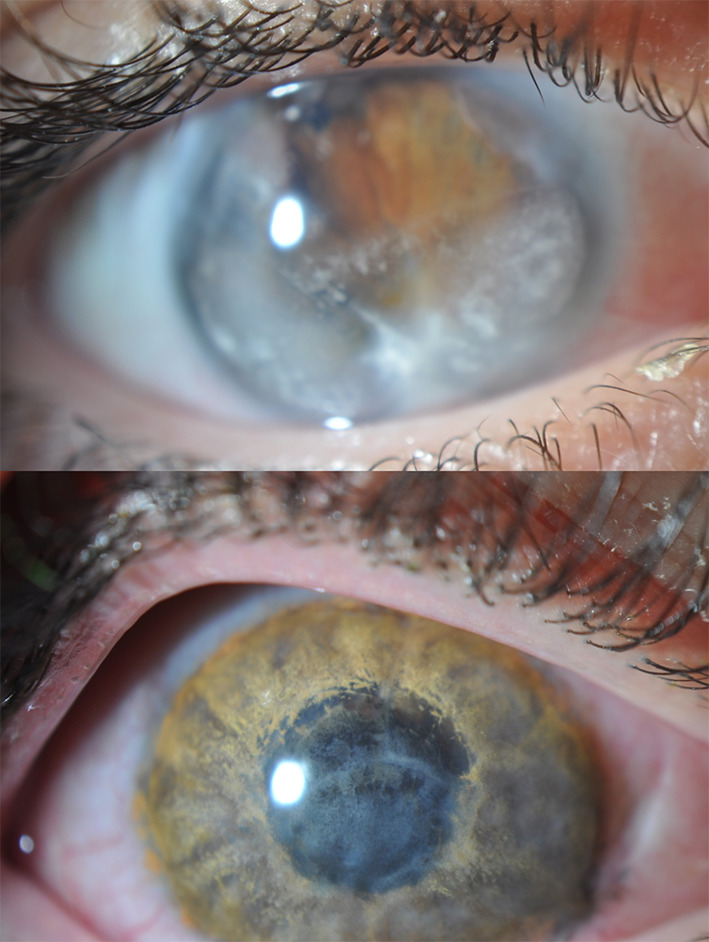
This image is not strictly laser, it's laser assisted with pigment insertion
https://pmc.ncbi.nlm.nih.gov/articles/PMC12271006/
The Damage: Laser targeting is rarely perfectly uniform across living tissue.
The Consequence: Many patients don't end up with clean blue eyes. Instead, they suffer from asymmetrical, patchy, or muddy multi-colored irises that cannot be corrected.
Study's take on pure laser procedures : ''Laser iris depigmentation offers a less invasive approach, using a Q-switched Nd:YAG laser to remove melanin from the anterior iris stroma. While it provides a natural-looking result, it lacks customization and has potential complications like patchy pigmentation, photophobia, and temporary intraocular pressure spikes. Additionally, there is limited long-term data on its safety.''
This image is not strictly laser, it's laser assisted with pigment insertion
https://pmc.ncbi.nlm.nih.gov/articles/PMC12271006/
The Damage: Laser targeting is rarely perfectly uniform across living tissue.
The Consequence: Many patients don't end up with clean blue eyes. Instead, they suffer from asymmetrical, patchy, or muddy multi-colored irises that cannot be corrected.
Study's take on pure laser procedures : ''Laser iris depigmentation offers a less invasive approach, using a Q-switched Nd:YAG laser to remove melanin from the anterior iris stroma. While it provides a natural-looking result, it lacks customization and has potential complications like patchy pigmentation, photophobia, and temporary intraocular pressure spikes. Additionally, there is limited long-term data on its safety.''
Likelihood of repigmentation (return to original darker colour) :
Full Repigmentation is rare, but color regression is common
The likelihood of your eye turning completely back to its original deep dark brown is relatively low. Once the superficial melanin granules are shattered and successfully vacuumed out of the eye by your immune system, those specific physical particles are gone forever.
However, the likelihood of partial repigmentation (regression into a muddy green, hazel, or darker gray) is high if the initial treatment was conservative. If the laser only clears the very top layer of the iris to protect the eye's drainage network from clogging, the deeper, surviving pigment factories will eventually push new melanin upward over a period of 1 to 3 years
Full Repigmentation is rare, but color regression is common
The likelihood of your eye turning completely back to its original deep dark brown is relatively low. Once the superficial melanin granules are shattered and successfully vacuumed out of the eye by your immune system, those specific physical particles are gone forever.
However, the likelihood of partial repigmentation (regression into a muddy green, hazel, or darker gray) is high if the initial treatment was conservative. If the laser only clears the very top layer of the iris to protect the eye's drainage network from clogging, the deeper, surviving pigment factories will eventually push new melanin upward over a period of 1 to 3 years
The Trigger: Laser-Induced Cellular Alarm
The main biological factor that drives the likelihood of repigmentation is inflammation.
The intense photoacoustic shockwaves of the laser cause localized cellular trauma.
Your body views this trauma as an injury. Just like how skin gets darker (post-inflammatory hyperpigmentation) after a severe burn or acne breakout, the surviving melanocytes in the deeper layers of the iris can enter a hyper-active healing mode.
They begin rapidly manufacturing brand-new melanosomes (melanin storage units) to heal the tissue, which slowly darkens the iris back down.
Insights from Medical Conditions (BADI)
Ophthalmologists get their best data on this phenomenon by studying a rare, natural medical condition called Bilateral Acute Depigmentation of the Iris (BADI).
In BADI, a patient's immune system spontaneously attacks their own iris pigment, causing their eyes to rapidly turn blue or gray.
Long-term medical tracking of BADI patients shows a consistent, heavily documented pattern of slow, gradual repigmentation and re-thickening of the iris over several years. This provides clear proof to scientists that the human iris naturally wants to revert to its genetically programmed color baseline if the pigment cells survive.
The main biological factor that drives the likelihood of repigmentation is inflammation.
The intense photoacoustic shockwaves of the laser cause localized cellular trauma.
Your body views this trauma as an injury. Just like how skin gets darker (post-inflammatory hyperpigmentation) after a severe burn or acne breakout, the surviving melanocytes in the deeper layers of the iris can enter a hyper-active healing mode.
They begin rapidly manufacturing brand-new melanosomes (melanin storage units) to heal the tissue, which slowly darkens the iris back down.
Insights from Medical Conditions (BADI)
Ophthalmologists get their best data on this phenomenon by studying a rare, natural medical condition called Bilateral Acute Depigmentation of the Iris (BADI).
In BADI, a patient's immune system spontaneously attacks their own iris pigment, causing their eyes to rapidly turn blue or gray.
Long-term medical tracking of BADI patients shows a consistent, heavily documented pattern of slow, gradual repigmentation and re-thickening of the iris over several years. This provides clear proof to scientists that the human iris naturally wants to revert to its genetically programmed color baseline if the pigment cells survive.
To avoid any chance of repigmentation, a clinic has to aggressively blast the iris over dozens of sessions to ensure total cell death of the melanocytes.
However, doing this drastically increases the likelihood of severe, sight-threatening complications:
The Filter Clogs: The more pigment blasted away to prevent regression, the higher the risk of completely choking the trabecular meshwork, causing permanent glaucoma.
Atrophy: Over-lasering causes the iris tissue to thin out and develop structural holes, leading to permanent light sensitivity and blurred vision.
However, doing this drastically increases the likelihood of severe, sight-threatening complications:
The Filter Clogs: The more pigment blasted away to prevent regression, the higher the risk of completely choking the trabecular meshwork, causing permanent glaucoma.
Atrophy: Over-lasering causes the iris tissue to thin out and develop structural holes, leading to permanent light sensitivity and blurred vision.
In conclusion minor complications are much more common compared to the more severe ones, those are treatable, temporary and many would argue that they are worth the results. The foggy area here is the lack of data, not evidence of safety or risk. Because this has not been around long enough, you are essentially taking the risk that something outside of what we currently know might happen to you in the future. Despite the concern on the available data being potentially biased (as in mostly good results being reported) due to it being published by the clinics offering the services and the ghost patient problem, pure laser depigmentation without keratopigmentation or implants remains the safest eye colour change procedure. Up to you to decide whether you want it badly enough or not.
Last edited:

