
FOR EDUCATION PURPOSE
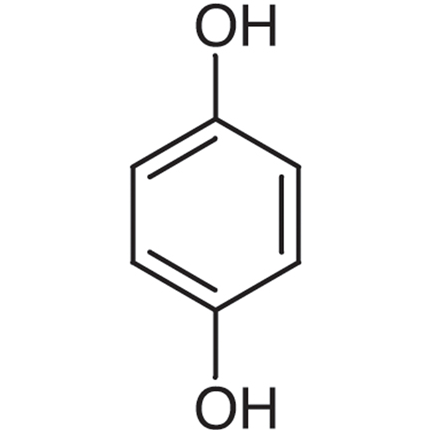
Hydroquinone is a phenolic compound it consists of a benzene ring and two OH ion group attached in para position its another name is ( benzene 1-4 diol ) the OH has two lone pair one attached to resonance structure and other chillin out so the lone pair is actually attached to pi bond and pi bond is a weak bond so its unstable because it is attached to pi bond its highly unstable cause the bond may break any time and the hydroquinone goes to oxidation at any time when exposed to air and light making it 1,4 benzoquinone which is also highly unstable ok it will turn brown dark brown or black in color when oxidized . it is sp2 hybridized 3 sigma bond and one lone pair wont count cause it is attached to resonance structure and one is not bonded
Hydroquinone is highly stable in acidic condition as you can see why
Hydroquinone is stable in acidic conditions because the high concentration of protons H+ suppresses its ionization and prevents oxidation into p-benzoquinone. Acids neutralize the reactive, easily oxidized phenoxide ions and semiquinone intermediates, locking hydroquinone in its neutral, stable form and preventing further degradation into p - benzoquinone or 1,4 benzoquinone
so what's the PH of this 3.5 to 5.5 lets not get its PH above 6
so is it unstable in basic condition well see it
Hydroquinone is unstable in basic conditions because its hydroxyl groups readily deprotonate, forming highly reactive phenoxide ions. These ions are incredibly sensitive to oxygen and easily undergo rapid auto-oxidation to form p-benzoquinone, which causes the solution to darken and lose its chemical effectiveness
rxn is this keep in mind C6H6O2 + O2 -------(LIGHT)--------- C6H4O2 + H202 RXN is already balanced so lets get to a real deal
so how to lower its conc this is imp
SO what do we know now sir we can dilute hydroquinone in 3.5 to 5.5 PH condition id say put it 3.5 so we can do a PH test but nah its unnecessary
never mix with peroxides ( etc hydrogen peroxide or benzoyl peroxide ) with phenol
SO day to day life compound with this PH what r these there are many but at 1st
Cetomacrogol Cream( basic cream )
basic cream ? we need to buffer this cream down its pretty neutral ill say but we have easy shi so we get down to other
Hyaluronic Acid Serums
so this is over the counter thing we can get this at any place ig this has PH of 4.5 to 4 lets say the only risk is to mix and this should be done in dim light ok yeah and if yo ass sees sum dark brown shi throw that away
To calculate how to dilute your 4% hydroquinone into a 1%, 2%, or 3% solution, you use the standard chemistry dilution formula taught (C1V1 = C2V2).
C1 = Initial concentration 4%
V1 = Volume of the 4% cream/solution you start with
C2 = Target concentration 1% .2%, or 3%
V2= Final volume of the mixture (V1+ amount of diluent added)
To make a 2% Solution (a 1:2 dilution)
4%* 10g=2% * V2 V2=20 total weight.
Take 10g OF 4% Hydroquinone and add 10g of Ha. 1 % is actually we need soo
to make a 1 % conc
10 g of 4 % hydroquinone and add 30g of ha
to make 3 %
unnecessary ig
NOW we add powerful anti oxidants cause Ros is created in hydroquinone via auto oxidation on free state
i got a few option l-vitamin c, vitamin e ,citric acid butylated Hydroxytoluene but i see Sodium Metabisulfite is a good one
or we can add all yk what i mean
.Sodium Metabisulfite 0.2–0.3% + Ascorbic Acid 1% + Citric Acid 0.2–0.5%
sodium Metabisulfite: 0.1 g per 40 g of final cream (0.25%)
Ascorbic Acid: 0.4 g per 40 g of final cream (1%)
Citric Acid: 0.1 g per 40 g of final cream (0.25%)
1st dissolve these in to propylene glycol small amount and then mix with HA the amount i told ok then mix the HA with HQ final verdict
n*****s my HQ is finished ill try it when ill buy it next time
CONSIDERATION
work on dim light
mix everything quick but 1st prepare the HA with antioxidant solution
then add HQ mix quick store it in air tight shi in fridge
Hydroquinone is a phenolic compound it consists of a benzene ring and two OH ion group attached in para position its another name is ( benzene 1-4 diol ) the OH has two lone pair one attached to resonance structure and other chillin out so the lone pair is actually attached to pi bond and pi bond is a weak bond so its unstable because it is attached to pi bond its highly unstable cause the bond may break any time and the hydroquinone goes to oxidation at any time when exposed to air and light making it 1,4 benzoquinone which is also highly unstable ok it will turn brown dark brown or black in color when oxidized . it is sp2 hybridized 3 sigma bond and one lone pair wont count cause it is attached to resonance structure and one is not bonded
Hydroquinone is highly stable in acidic condition as you can see why
Hydroquinone is stable in acidic conditions because the high concentration of protons H+ suppresses its ionization and prevents oxidation into p-benzoquinone. Acids neutralize the reactive, easily oxidized phenoxide ions and semiquinone intermediates, locking hydroquinone in its neutral, stable form and preventing further degradation into p - benzoquinone or 1,4 benzoquinone
so what's the PH of this 3.5 to 5.5 lets not get its PH above 6
so is it unstable in basic condition well see it
Hydroquinone is unstable in basic conditions because its hydroxyl groups readily deprotonate, forming highly reactive phenoxide ions. These ions are incredibly sensitive to oxygen and easily undergo rapid auto-oxidation to form p-benzoquinone, which causes the solution to darken and lose its chemical effectiveness
rxn is this keep in mind C6H6O2 + O2 -------(LIGHT)--------- C6H4O2 + H202 RXN is already balanced so lets get to a real deal
so how to lower its conc this is imp
SO what do we know now sir we can dilute hydroquinone in 3.5 to 5.5 PH condition id say put it 3.5 so we can do a PH test but nah its unnecessary
never mix with peroxides ( etc hydrogen peroxide or benzoyl peroxide ) with phenol
SO day to day life compound with this PH what r these there are many but at 1st
Cetomacrogol Cream( basic cream )
basic cream ? we need to buffer this cream down its pretty neutral ill say but we have easy shi so we get down to other
Hyaluronic Acid Serums
so this is over the counter thing we can get this at any place ig this has PH of 4.5 to 4 lets say the only risk is to mix and this should be done in dim light ok yeah and if yo ass sees sum dark brown shi throw that away
To calculate how to dilute your 4% hydroquinone into a 1%, 2%, or 3% solution, you use the standard chemistry dilution formula taught (C1V1 = C2V2).
C1 = Initial concentration 4%
V1 = Volume of the 4% cream/solution you start with
C2 = Target concentration 1% .2%, or 3%
V2= Final volume of the mixture (V1+ amount of diluent added)
To make a 2% Solution (a 1:2 dilution)
4%* 10g=2% * V2 V2=20 total weight.
Take 10g OF 4% Hydroquinone and add 10g of Ha. 1 % is actually we need soo
to make a 1 % conc
10 g of 4 % hydroquinone and add 30g of ha
to make 3 %
unnecessary ig
NOW we add powerful anti oxidants cause Ros is created in hydroquinone via auto oxidation on free state
i got a few option l-vitamin c, vitamin e ,citric acid butylated Hydroxytoluene but i see Sodium Metabisulfite is a good one
or we can add all yk what i mean
.Sodium Metabisulfite 0.2–0.3% + Ascorbic Acid 1% + Citric Acid 0.2–0.5%
sodium Metabisulfite: 0.1 g per 40 g of final cream (0.25%)
Ascorbic Acid: 0.4 g per 40 g of final cream (1%)
Citric Acid: 0.1 g per 40 g of final cream (0.25%)
1st dissolve these in to propylene glycol small amount and then mix with HA the amount i told ok then mix the HA with HQ final verdict
n*****s my HQ is finished ill try it when ill buy it next time
CONSIDERATION
work on dim light
mix everything quick but 1st prepare the HA with antioxidant solution
then add HQ mix quick store it in air tight shi in fridge


