
- Joined
- Jul 14, 2026
- Messages
- 7,151
- Solutions
- 3
- Online time
- 25d 3h
- Reputation
- 20,496
Microneedling is a process in which, you guessed it, small needles are inserted into your face to produce punctures. These punctures trigger new collogen synthesis to activate the skin to produce its own collogen and elastin cells; these cells allow for a more youthful and better skin quality.
The skin comprises three primary layers: the epidermis, dermis, and subcutaneous tissue. The epidermis acts as a protective barrier, while the dermis contains collagen and elastin fibers that provide structural support and elasticity. Microneedling primarily targets the dermis, creating micro-wounds that stimulate the body’s natural healing processes without causing significant damage to the epidermis. This targeted injury promotes collagen synthesis and skin remodeling, making microneedling an effective treatment for various dermatological conditions. One of the most significant biological responses to microneedling is collagen induction. The micro-injuries initiate a wound-healing cascade, releasing growth factors and activating fibroblasts responsible for producing collagen and elastin. Research has demonstrated that microneedling enhances collagen deposition and reorganization, improving skin texture and elasticity over time. In addition to collagen induction, microneedling promotes neo-vascularization or the formation of new blood vessels. This process enhances blood supply to the treated area, improving nutrient delivery, and supporting the healing process. Increased vascularity contributes to healthier, more vibrant skin and improves the healing of scars and other skin lesions. Another significant advantage of microneedling is its ability to enhance transdermal drug delivery. The needles' micro-channels allow for better penetration of topical agents, such as serums containing vitamins or growth factors. Once the punctures have been made, multiple inflammatory mediators help in the recovery of the skin. Initially, transforming growth factors (TGF), platelet-derived growth factors (PDGF), and connective tissue activation protein (CTAP) are released from surrounding cells. These growth factors provide cell support and cell communication. A fibronectin matrix forms after 5 days of injury that determines collagen deposition, resulting in skin tightening and persisting for 5 to 7 years in the form of collagen III. The depth of neocollagenesis is 5 to 600 µm when a 1.5-mm length needle is used for the procedure. Histological examination of the skin treated with 4 microneedling sessions 1 month apart shows a 400% increase in collagen and elastin deposition at 6 months postoperatively, with a thickened stratum spinosum and normal rete ridges at 1 year postoperatively.
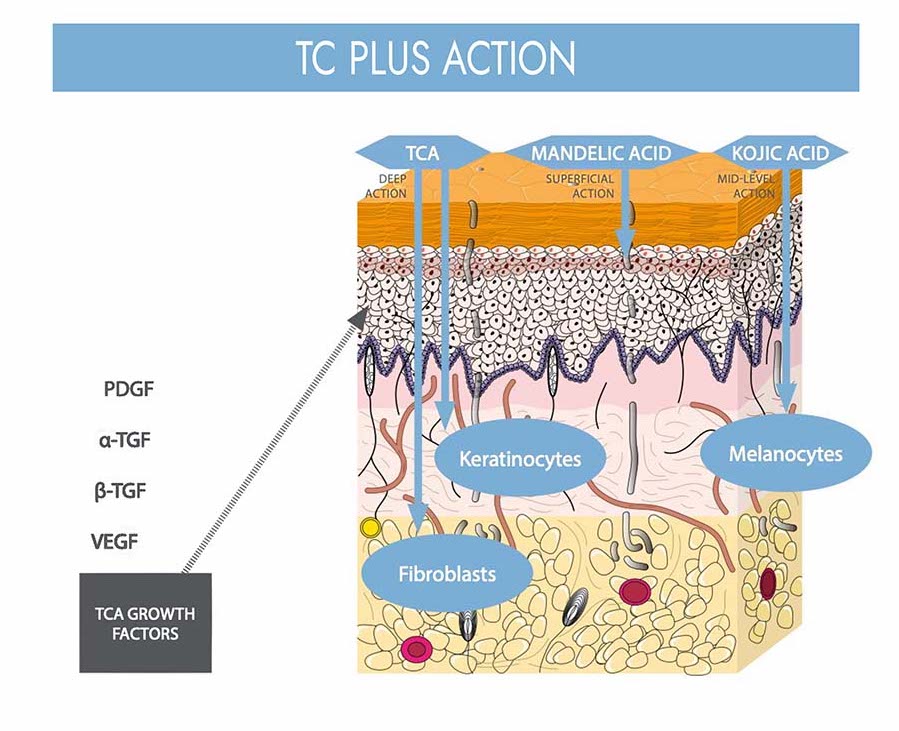
When comparing microneedling to other skin rejuvenation techniques, it is essential to consider their unique mechanisms and outcomes. Laser therapy, for example, uses focused light energy to target specific skin layers, often resulting in more significant thermal damage than microneedling. While laser treatments can deliver dramatic results, they may also carry a higher risk of side effects, particularly in individuals with darker skin tones due to potential pigmentation changes. Chemical peels involve the application of acidic solutions to exfoliate the outer layers of the skin. Although effective for addressing superficial skin issues, chemical peels can irritate and require downtime for recovery. Microneedling, on the other hand, allows for deeper skin penetration with minimal downtime, making it suitable for a broader range of skin types and conditions. Dermabrasion, another technique, mechanically sands the skin’s surface to remove the outer layers. This method can lead to significant downtime and is associated with a higher risk of complications. In comparison, microneedling offers a gentler alternative, promoting healing while minimizing damage to the epidermis, thereby reducing recovery time and potential adverse effects. Radiofrequency microneedling is another technique that adds a layer of thermal energy to the standard process. The needles deliver heat directly into the dermis as they penetrate, which triggers an additional round of collagen remodeling at a deeper level. Some studies show that improvements continue up to six months post-treatment, with particularly strong outcomes for skin tightening and deeper acne scars. But the risks of burning the skin, prolonged swelling, redness, and hyperpigmentation are one to consider. In my opinion this is not needed in microneedling as many do not need the extra collagen at this time in their life.
WARNING THIS SHOULD NOT BE DONE WITH ACNE
A dermastamp is a small, handheld device equipped with clustered fine needles that are pressed vertically into the skin, rather than rolled across it like a derma roller. This vertical stamping motion allows for precise treatment, making it ideal for small or hard-to-reach areas, such as acne scars, fine lines, or the scalp. The dermastamp can be lackluster in some areas as the face goes deeper in some places while the stamp remains the same depth. I tend to see people bash this product for this, but in overall effectiveness it is still near the top as most people will not need a deeper puncture. Also, the stamp requires human pressing which can alter the puncture in different areas.
Application (Use at LEAST .5mm)
First, cleanse your face with wash or face wipes. No water is not enough.
Next (optional but encouraged) Apply hyaluronic acid to your face to help the stamp not create unneeded tears into the skin.
After this- Gently press the derma stamp straight into the skin. Hold the tool for 1 to 2 seconds, then lift it and move to the next spot. Avoid dragging or sliding the tool across the skin to prevent irritation. Cover the full area evenly by overlapping slightly in a grid pattern.
Now many suggest applying a fragrance-free moisturizer after stamping to calm the skin, or some say apply tret as it will allow for more collogen absorption. But on the other hand, some say to leave the skin alone to ensure that the skin has time to rest and soak in the benefits of the stamping, I suggest leaving the face alone for 8 hours as we do not what to add any extra things that may disrupt the recovery process. I would love to hear others' opinions on this, though. No matter what, it is best to stay clear of the sun for 24–48-hour post op as the skin will be extra sensitive to UV rays. Also make sure to use a different cartridge as the needles can dull. But some say cleaning is enough, but I tend to disagree with this.

Application (Use at LEAST .5mm)
First, cleanse your face with wash or face wipes. No water is not enough.
Next (optional but encouraged) Apply hyaluronic acid to your face to help the stamp not create unneeded tears into the skin.
After this- Gently press the derma stamp straight into the skin. Hold the tool for 1 to 2 seconds, then lift it and move to the next spot. Avoid dragging or sliding the tool across the skin to prevent irritation. Cover the full area evenly by overlapping slightly in a grid pattern.
Now many suggest applying a fragrance-free moisturizer after stamping to calm the skin, or some say apply tret as it will allow for more collogen absorption. But on the other hand, some say to leave the skin alone to ensure that the skin has time to rest and soak in the benefits of the stamping, I suggest leaving the face alone for 8 hours as we do not what to add any extra things that may disrupt the recovery process. I would love to hear others' opinions on this, though. No matter what, it is best to stay clear of the sun for 24–48-hour post op as the skin will be extra sensitive to UV rays. Also make sure to use a different cartridge as the needles can dull. But some say cleaning is enough, but I tend to disagree with this.
Dermapen is a handheld, pen-shaped device used for microneedling. Unlike traditional derma rollers, Dermapen uses spring-loaded, automated needles that move vertically, allowing precise control over needle depth and minimizing damage to surrounding skin.
First, just like the stamp, we want to clean our face with wipes preferably, or a wash.
Next, apply numbing cream to your face all over. It is better to be safe than sorry, so add extra if you feel like you're not adding enough. Allow the cream to dry and soak into your skin for 30 minutes.
After, remove any extra cream that may be left over with a wipe.
Finally (at 2 speed) go down and across your face in order from; forehead (1mm), left side of face (1.5mm), bottom of face (1mm), right side of face (1.5mm), eyebrows undereye and nose (.5mm and 1 speed). Zygos should also be 1mm.
After 24 you can apply lukewarm water and after 48 you can go back to applying your normal routine.

First, just like the stamp, we want to clean our face with wipes preferably, or a wash.
Next, apply numbing cream to your face all over. It is better to be safe than sorry, so add extra if you feel like you're not adding enough. Allow the cream to dry and soak into your skin for 30 minutes.
After, remove any extra cream that may be left over with a wipe.
Finally (at 2 speed) go down and across your face in order from; forehead (1mm), left side of face (1.5mm), bottom of face (1mm), right side of face (1.5mm), eyebrows undereye and nose (.5mm and 1 speed). Zygos should also be 1mm.
After 24 you can apply lukewarm water and after 48 you can go back to applying your normal routine.
This shit is cope don't do it LOL


