
- Joined
- Jul 14, 2026
- Messages
- 8,957
- Solutions
- 5
- Online time
- 1mo 6d
- Reputation
- 27,118
Why and What is this handbook?
This handbook will be a basic walkthrough of all the terms, definitions, and exercises you need to understand SBL. Now I am making this because I truly believe that SBL is the future of the gym. With the use of social media, you can see the influence of SBL on the youth, and this will continue to grow. I mean, only 4 years ago I felt science based for doing JPG pulldowns and sissy squats after my quad extension. To add onto that, I was one of the few, if not the only person in my gym with straps; now everyone and their mom has them. So if this doesn't prove that the SBL community will only grow and become the future of the gym, idk what will.
The Vocab Needed
In this section, I will be providing common and more niche terms that you will hear in mine or others' conversations when related to lifting.
Mechanical tension- which is the force placed on muscle fibers when they actively contract against resistance. To maximize mechanical tension, you need to train very closely or to failure. Failure is when you are unable to get another repetition with adequate form.
Progressive overload- Progressive overload is a principle of hypertrophy in which you progress in your lifts over time, whether that'd be increasing the weight/resistance, doing more repetitions or improving form.
RIR- Reps in Reserve refers to the number of reps left until failure is reached. For instance, a set of 2 reps in reserve (RIR) means that two repetitions were left until failure was reached. Research shows that there is virtually zero extra hypertrophic benefit between failure and 1-2 RIR.
(These 3 definitions can be credited to Roysbit from Nutria. Basic definitions but still credit to him)
CNS- Central Nervous System, the brain and spinal cord that controls and coordinates all voluntary movement, reaction, and muscle activation. The CNS is your body’s command center for physical activity. It sends electrical signals from the brain and spinal cord to muscles, joints, and organs, enabling movement, coordination, and reaction. The CNS is essential for analyzing intra- and extra personal information and crafting coordinated responses, thereby acting as the body control center. To give an example of how we can use CNS in our workouts, while performing a seated lateral raise with your arms out, hold onto your wrist wraps and this will active the neurons telling your body to output maximal force for the lift.
CNS Fatigue- CNS fatigue cis when chronic overtraining fatigues the central nervous system to the point of inefficiency. We see this in the gym when performing bilateral movements and not giving the proper rest between sides. Yes, when doing a bilateral movement, you need to give at least a 30-60 second rest between the left and right side. Failing to do so can result in said CNS fatigue limiting the force output on the latter side.
Frequency- The amount of time a muscle group is hit in a week. So, for example, U/L 6x would provide 3x frequency while PPL/PPL would only provide 2x. 3x is the superior frequency due to MPS which I will cover now.
Muscle Protein Synthesis (MPS)- Muscle protein synthesis (MPS) is the cellular process of building new muscle proteins from amino acids, and it is the primary driver of muscle growth, repair, and adaptation in response to training and nutrition. Research shows that MPS can remain elevated for 24-48 hours of post-exercise, with peak rates occurring within the first 1-3 hours and going back to baseline after 48-72 hours. So, knowing this, we would want to capitalize on this window. That is why splits that involve 3x frequency are superior, they catch the MPS when it is on the fall allowing it to spike again and maximize gains.
ROM- Range of Motion
Rate coding- Rate coding is a mechanism your nervous system uses to control how much force a muscle produces by changing how frequently motor units are fired. Instead of only increasing force by recruiting more muscle fibers, the nervous system can also increase force by increasing the firing rate of the motor units that are already active now. This becomes relevant once a muscle is already working at a high level, because it provides more support for the units working and only a few motor units are left to recruit.
Motor Recruitment- motor recruitment is the process by which your nervous system activates additional muscle fibers (motor units) to increase force, following Henneman’s size principle — small, fatigue‑resistant units fire first, with larger, more powerful units added as demand rises. So why does this matter? Recruiting more motor units activates more muscle fibers, increasing the total cross-sectional area that can grow.
Motor Unit- A motor unit is made up of a motor neuron and all of the muscle fibers it controls. When your CNS activates a muscle, it doesn't directly activate individual fibers one by one but instead recruits motor units as a whole. Once a motor unit is recruited, it does not fire only once; it sends repeated electrical impulses to the muscle fibers it controls to maintain force. When the force demands increase, the nervous system increases the firing frequency of the motor units that are already active. This means the time interval between each electrical impulse becomes shorter, and signals are sent more rapidly. Because these impulses are closer together, the muscle fibers don't fully relax between contractions. Instead, the individual twitches begin to overlap, which changes the overall pattern of force production from separate contractions into a more continuous output. This is beneficial as it will allow our body to have more force output in each individual rep, leading to more hypertrophy. (Not directly I know but it is a part of the line of cause.
Motor Cortex- This is the area of the cortex (brain) associated with movement. The primary motor cortex contains large neurons with triangular-shaped cell bodies that are called pyramidal neurons; these are the primary output cells of the motor cortex. The axons of pyramidal cells leave the motor cortex carrying information about a desired movement and enter one of the tracts of the pyramidal system, which includes the corticospinal and corticobulbar tracts. Both tracts carry information about voluntary movement down from the cortex; the corticospinal tract carries such information to the spinal cord to initiate movements of the body, while the corticobulbar tract carries motor information to the brainstem to stimulate cranial nerve nuclei and cause movements of the head, neck, and face. Pyramidal neurons of the motor cortex are also known as upper motor neurons. They form connections with neurons called lower motor neurons, which directly innervate skeletal muscles to cause movement.
Antagonist Inhibition- Reciprocal inhibition is a neuromuscular process in which muscles on one side of a joint relax to allow the contraction of muscles on
the opposite side, enabling smooth and coordinated movement.
Ascending profile- Ascending strength profiles occur when maximum force is produced near the end of a movement, as seen in exercises like the bench press, squat, leg press, and power clean. These movements benefit from mechanical advantage as joints approach full extension, allowing muscles to generate more force later in the lift
Descending profile- Descending strength profiles produce maximum force at the beginning of the movement, typically in pull-ups, chin-ups, lat pull-downs, and bent-over rows. Here, muscles are strongest at the start, and force decreases as the lift progresses. Or what I mention the most, in a curl variant.
Length-tension relationship: A muscle makes the most force at a middle length, where the most muscle-fiber cross-bridges can connect. If it is too short, the filaments overlap too much and force drops. If it is too long, they overlap too little and active force drops, although stretch adds passive tension.
Active insufficiency: When a two-joint muscle is shortened at one joint, it has less ability to shorten at the other. It runs out of usable length and can’t produce much force.
Frontal plane: separates the front (anterior) and back (posterior) of the body. Now, when I use this term, it is usually referring to the bias of the lats. A frontal plane lat movement refers to movements like a lat pulldown or a Keenan flap; these bias the lats.
Sagittal (longitudinal) plane: separates the left and right sides of the body. Again, for the lats, this will be movements like a row or a lat pullover, biasing the lats.
Transverse (axial) plane: separates the upper (superior) and lower (inferior) halves of the body
What Actually Grows Muscles
And no its not muh microtears, JFL
Muscle growth is the result of net protein gain. Over time, muscle protein synthesis (MPS) has to exceed muscle protein breakdown (the balance that drives fiber growth). Lifting hard is what tips that balance. What happens after a hard session. Muscle cells can’t divide to make new cells. Muscle enlargement therefore depends on existing fibers getting bigger. A classic study found that after weightlifting, protein synthesis rose 112% at 3 hours and stayed 65% above rest at 24 hours and 34% above at 48 hours (Phillips et al., 1997). Later work added a nuance. Early increases in MPS appear to go toward repairing training-induced damage, and they contribute to growth only as that damage fades (Damas et al., 2018). This is one reason beginners, who get sore easily, don’t see the full growth effect right away. Satellite cells. These are stem cells on the outside of each fiber. After a bout of resistance exercise their proliferation is typically detectable by 24 hours and peaks around 72 hours, and they add new nuclei to the fiber, which raises its capacity to keep growing. Volume. A meta-analysis of 15 studies found a graded dose-response, where more weekly sets produced more growth (Schoenfeld et al., 2017). Average gains were 5.4% for fewer than 5 weekly sets per muscle, 6.6% for 5 to 9 sets, and 9.8% for 10 or more. A later trial in trained men found a similar pattern for muscle size. It compared low-, moderate-, and high-volume programs in 34 resistance-trained men (Schoenfeld et al., 2019), and hypertrophy rose with volume while strength gains were similar. The evidence isn’t unanimous, though. Some studies in trained people at higher volumes have not found a dose-response, while others have. Protein. In a meta-analysis of 49 studies with 1,863 participants, the gains in fat-free mass stopped increasing above a total protein intake of about 1.62 g per kg of body weight per day (Morton et al., 2018). The exact breakpoint is uncertain. The 95% confidence interval ran from 1.03 to 2.20 g/kg/day, and some analysts argue the true plateau may be higher. Treat 1.6 to 2.2 g/kg/day as a reasonable target range.
The main Body Parts and What Function Targets Them
In this section, I will be going over the basic human anatomy that describes the bodily functions that isolate and hit the different muscles. This will be important when advising others. Many exercises, a chest fly and a chest press, are repetitive, as not only are they both shoulder adduction, but they both target the mid chest.
Lats
The lats start on the lower spine and pelvis and attach to the front of the upper arm bone (the humerus). Their fibers run diagonally up and outward, so when they shorten they pull the arm down and back toward the body. That is shoulder extension and adduction. In a pulldown or pull-up, your arm moves from overhead down to your side, which is exactly the path the lat shortens along.

Front delts
The front deltoid attaches on the front of the collarbone and runs down to the upper arm. When it contracts, it lifts the arm forward and up. That is shoulder flexion. Front raises isolate this movement, and overhead presses use it to push the arm upward.

Side delts
The side (middle) deltoid starts on the top of the shoulder blade (the acromion) and attaches to the outer upper arm. Its fibers run straight down the side of the shoulder, so shortening them lifts the arm straight out to the side. That is shoulder abduction. Lateral raises copy this motion directly.

Quads
The four quad muscles join into one tendon that crosses the front of the knee and attaches below the kneecap. Shortening that tendon pulls the lower leg forward and straightens the knee. That is knee extension. In a leg extension or the standing-up phase of a squat, the quads shorten to straighten the knee against the weight.

Hamstrings
The hamstrings start on the sit bone of the pelvis and run down the back of the thigh to just below the knee. Because they cross both joints, they do two jobs. Shortening them bends the knee (knee flexion), which is what a leg curl trains. They also pull the thigh backward (hip extension), which is why Romanian deadlifts train them.

Adductors
The adductors are the inner thigh muscles. They start on the pelvis near the groin and attach along the inner thigh bone. Their fibers run toward the midline, so shortening pulls the leg inward toward the other leg. That is hip adduction, trained by the adductor machine.

Abductors
The abductors are the outer hip muscles, mainly the glute medius and glute minimus. They start on the side of the pelvis and attach to the top outer part of the thigh bone. Shortening them pulls the leg out to the side, away from the midline. That is hip abduction, trained by the abductor machine and side-lying leg raises.

Biceps
The biceps start on the shoulder blade and attach to the forearm bone (the radius), crossing the front of the elbow. Shortening them pulls the forearm up toward the upper arm. That is elbow flexion. The biceps also rotate the palm upward (supination), so curling with your palms facing up trains them harder.

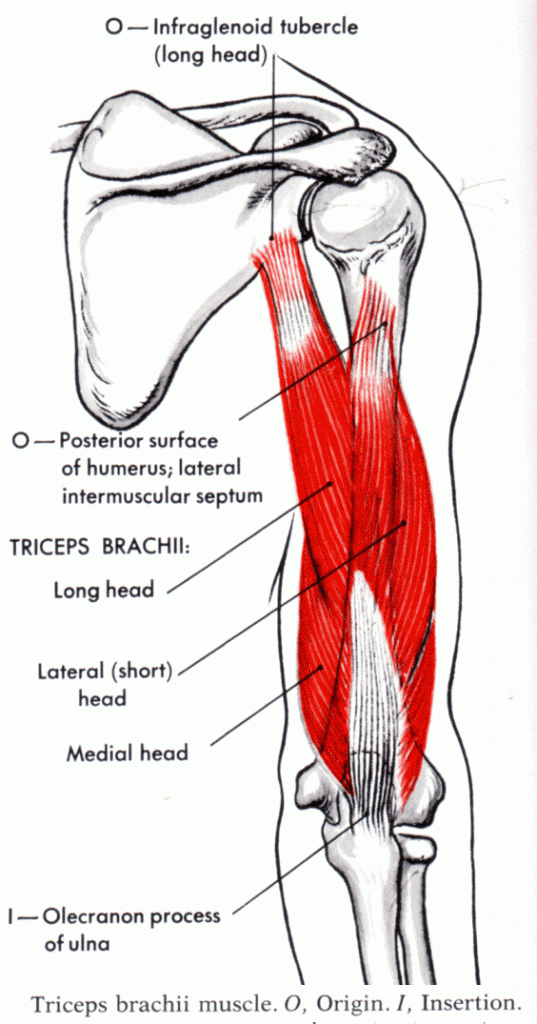
Triceps
The triceps run down the back of the upper arm and attach to the point of the elbow. Shortening them pulls the elbow straight. That is elbow extension, the opposite of the biceps. Pushdowns and skull crushers work against the weight while the arm straightens.
Abs
The rectus abdominis is a vertical muscle running from the ribcage down to the pelvis. When it shortens, it pulls the ribcage and pelvis toward each other and curls the trunk forward. That is spinal flexion. In a crunch, the ribs move toward the hips, which is the shortening of the muscle itself.

Chest
The pecs start on the collarbone and breastbone and attach to the upper arm, with their fibers running across the front of the body. Shortening pulls the arm across the chest toward the midline. That is horizontal adduction, which is the motion in a fly or at the end of a bench press. Bench presses also use shoulder flexion, mainly from the upper part of the chest.

Back (upper back)
The rhomboids and middle traps run between the spine and the inner edge of the shoulder blade. Shortening them pulls the shoulder blades toward the spine and back toward each other. That is scapular retraction, and rows and face pulls train it. The lower back (erector spinae) runs along the spine and extends it, as in back extensions.

In this section, I will be going over the basic human anatomy that describes the bodily functions that isolate and hit the different muscles. This will be important when advising others. Many exercises, a chest fly and a chest press, are repetitive, as not only are they both shoulder adduction, but they both target the mid chest.
Lats
The lats start on the lower spine and pelvis and attach to the front of the upper arm bone (the humerus). Their fibers run diagonally up and outward, so when they shorten they pull the arm down and back toward the body. That is shoulder extension and adduction. In a pulldown or pull-up, your arm moves from overhead down to your side, which is exactly the path the lat shortens along.
Front delts
The front deltoid attaches on the front of the collarbone and runs down to the upper arm. When it contracts, it lifts the arm forward and up. That is shoulder flexion. Front raises isolate this movement, and overhead presses use it to push the arm upward.
Side delts
The side (middle) deltoid starts on the top of the shoulder blade (the acromion) and attaches to the outer upper arm. Its fibers run straight down the side of the shoulder, so shortening them lifts the arm straight out to the side. That is shoulder abduction. Lateral raises copy this motion directly.
Quads
The four quad muscles join into one tendon that crosses the front of the knee and attaches below the kneecap. Shortening that tendon pulls the lower leg forward and straightens the knee. That is knee extension. In a leg extension or the standing-up phase of a squat, the quads shorten to straighten the knee against the weight.
Hamstrings
The hamstrings start on the sit bone of the pelvis and run down the back of the thigh to just below the knee. Because they cross both joints, they do two jobs. Shortening them bends the knee (knee flexion), which is what a leg curl trains. They also pull the thigh backward (hip extension), which is why Romanian deadlifts train them.
Adductors
The adductors are the inner thigh muscles. They start on the pelvis near the groin and attach along the inner thigh bone. Their fibers run toward the midline, so shortening pulls the leg inward toward the other leg. That is hip adduction, trained by the adductor machine.
Abductors
The abductors are the outer hip muscles, mainly the glute medius and glute minimus. They start on the side of the pelvis and attach to the top outer part of the thigh bone. Shortening them pulls the leg out to the side, away from the midline. That is hip abduction, trained by the abductor machine and side-lying leg raises.
Biceps
The biceps start on the shoulder blade and attach to the forearm bone (the radius), crossing the front of the elbow. Shortening them pulls the forearm up toward the upper arm. That is elbow flexion. The biceps also rotate the palm upward (supination), so curling with your palms facing up trains them harder.
Triceps
The triceps run down the back of the upper arm and attach to the point of the elbow. Shortening them pulls the elbow straight. That is elbow extension, the opposite of the biceps. Pushdowns and skull crushers work against the weight while the arm straightens.
Abs
The rectus abdominis is a vertical muscle running from the ribcage down to the pelvis. When it shortens, it pulls the ribcage and pelvis toward each other and curls the trunk forward. That is spinal flexion. In a crunch, the ribs move toward the hips, which is the shortening of the muscle itself.
Chest
The pecs start on the collarbone and breastbone and attach to the upper arm, with their fibers running across the front of the body. Shortening pulls the arm across the chest toward the midline. That is horizontal adduction, which is the motion in a fly or at the end of a bench press. Bench presses also use shoulder flexion, mainly from the upper part of the chest.
Back (upper back)
The rhomboids and middle traps run between the spine and the inner edge of the shoulder blade. Shortening them pulls the shoulder blades toward the spine and back toward each other. That is scapular retraction, and rows and face pulls train it. The lower back (erector spinae) runs along the spine and extends it, as in back extensions.
SBL exercises
In this section, I will go over the most common SBL exercises that you may see in a conversation.
Toosa/recline curls
A toosa curl is a variant of a recline curl, so I have grouped them together. These are the superior options for your biceps, as they allow for a better descending profile and give the bicep a more lengthened position. The biceps brachii has its optimal leverage near full elbow flexion (~110°). In a descending profile, resistance is reduced as the elbow approaches full extension, aligning with the brachioradialis’ mechanical advantage in that region. This allows the muscle to work efficiently where it’s strongest, while still being challenged where it’s weaker. By lowering resistance at the top of the curl, you avoid overloading the biceps in a mechanically disadvantaged position. This helps maintain consistent tension through the entire range of motion, which is important for hypertrophy, especially for the long head of the biceps that benefits from lengthened-position tension. Near full elbow extension, the biceps are at a mechanical disadvantage. A descending profile mitigates this by lightening the load in that zone, making it easier to control the weight and maintain form
Keenan flap
The Keenan Flap is a unilateral, lat‑focused cable exercise that is performed in the frontal plane. The Keenan Flap is designed to emphasize the lower fibers of the latissimus dorsi while also engaging the teres major depending on your movement bias. By focusing on spreading and then gently pulling the shoulder blades while keeping ribs down and neck long, the exercise promotes scapular stability and rear‑shoulder activation. This eliminated any scapular retraction that troubles many in a heavy wide grip lat pulldown, proving to be the better option for the lats. These can be done sitting or standing.
Kelso Shrug
A Kelso shrug is an upper back movement that COMPLETELY eliminates any bicep movement that may hinder a lifter in a regular row. Also, it is a way simpler and easier to overload movement. By performing scapular retraction on a row machine, it allows the upper back to be the sole focus of the movement. And if you want to learn more about this movement and its origins, and I'm not joking when I say this, there is an entire book based on it. Just search up "Kelso Shrug Book".
Quad Extensions
Now you may be asking yourself; quad extension isn't science-based? But it is how you perform it, and more particularly how we engage in the rectus femoris. The rectus femoris (RF) gets less involved when the hip is bent (sitting upright) and more involved when the hip is open (leaning back). Leaning back doesn’t switch it off. It does the opposite. (RF) gets less involved when the hip is bent (sitting upright) and more involved when the hip is open (leaning back). Leaning back doesn’t switch it off. It does the opposite. The two key drivers of this are Length-tension relationship and Active insufficiency. Now when sitting upright (hip bent about 80 to 90°) bending the hip brings the RF’s origin on the pelvis closer to its insertion at the knee, so the muscle starts the lift already partly shortened. When the knee extends, the RF shortens further. Now it is short at both ends, which is active insufficiency, so it produces little force. The three single-joint vasti are not affected by hip angle, so they take over most of the work. The seat back holds your hip still, so the RF never needs to flex the hip. The result would be that the knee-extension torque comes mostly from the vati, and the RF is a weak contributor. Now, when leaning back (hip more open). Opening the hip pulls the RF’s origin away from the knee, so the muscle starts the lift in a longer position. At that longer length, it sits closer to the best part of its length-tension curve and also has some passive tension from stretch. It can produce more force. As the knee extends, it shortens from this better starting point, so it stays useful through more of the range. Result is the RF contributes more to the lift and works harder, along with the vasti.
SBL Equipment
This section will go over the known equipment that is tied to SBL and why it is needed
Mouthguard- Once again I know this sounds crazy but stay with me here. During heavy lifts, many lifters unconsciously clench their teeth to “bear down” on the bar. This activates jaw muscles and can stimulate the CNS by increasing neural drive to the muscles. A well-fitted mouth guard allows this clenching without damaging teeth, helping maintain the neural feedback loop that supports strength and power output. Research shows that jaw clenching on a performance mouth guard can produce small-to-moderate gains in strength and power — sometimes up to a few percent more muscle force and faster rate of force development. This can translate to slightly heavier lifts or more reps over time, which is a CNS-level benefit because it increases the neural capacity to recruit and coordinate muscle fibers. Some studies note that jaw clenching with a mouth guard can lower post-session cortisol (a stress hormone) and improve recovery. Lower stress hormone levels can help the CNS recover faster, reducing fatigue and preserving neuromuscular efficiency for subsequent sets or sessions.
Seat belts- Now I know that this may sound crazy to some, but yes, a seat belt is needed in the gym. A gym seat belt is an extra-long strap that routes around the machine’s seat or frame, then secures you with a quick-release buckle. The belt locks you into position, so the weight stack stays focused on the intended movement. The seat belt is designed to keep you securely positioned during heavy leg extensions, seated hamstring curls and other machine-based movements where the weight stack can start pulling you out of the seat. Because the seat belt is not a commonly used equipment, studies are lacking in numbers. But I and many others can tell you firsthand that using the belt on said movements can lead to high weight, more stable lifts, and overall high muscle growth.
Gym pins- A gym pin is a metal rod or pin used in pin-loaded or selectorized gym machines to add extra weight to a machine’s stack. It acts as a weight holder and ensures the plates or stack are securely engaged during exercises. This will allow for heavy stacks to be used on machines like; leg extensions, seated hamstring curls, and adduction/abduction machines. Using heavier weight will advance the muscle hypertrophy and help grow said muscles. Although many gyms do not allow the pin, if this is the case I suggest doing the exercise unliterally.
@Jack Frost @zennn @citadelcel @Hypertrophy @Mulatto @batluvr158 @hoodsickle @TonyDr @Mr. Oxytocin @Slut @XWJ @CXO @giga.mia
idk who else to tag bc this isnt really looksmaxxing jfl. had to post this late tn bc Im busy tmr so bump ts
idk who else to tag bc this isnt really looksmaxxing jfl. had to post this late tn bc Im busy tmr so bump ts


